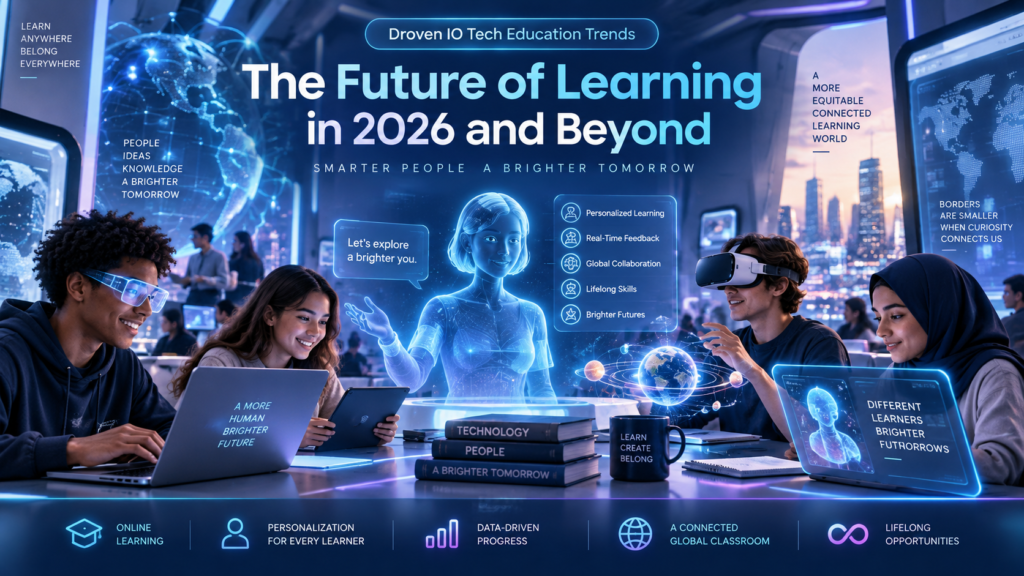
Education is changing faster than ever before. The Droven IO tech education trends of 2026 are reshaping how Americans learn, work, and grow in every industry. From AI-powered classrooms to virtual reality simulations, the digital learning transformation is real and accelerating right now.
You don’t need a traditional degree to build a successful career anymore. What you need is the right skills, the right tools, and the right mindset. Today’s education innovation trends are making quality learning accessible to every American, regardless of zip code, background, or budget. Understanding these shifts is not just interesting but absolutely essential for staying competitive.
Don’t Miss: Connections Hint Mashable: The Ultimate Guide
The Evolution of Education Technology
The journey of education technology trends did not happen overnight. It began with PowerPoint replacing chalkboards, grew into learning management systems, then exploded into the AI-powered education systems and data-rich ecosystem we have today. COVID-19 cracked the old model wide open permanently.
American institutions discovered that online learning evolution could deliver richer and more flexible experiences than traditional classrooms ever did. The digital learning transformation sweeping the USA is now feeding itself, as AI, cloud computing, immersive tech, and skills-based models all accelerate each other simultaneously.
Artificial Intelligence in Education
How AI is changing education in 2026 goes far beyond automated grading. AI now analyzes learning behavior, predicts dropout risk, and adapts content in real time for every individual student. The benefits of AI in learning are visible in classrooms from California to New York.
AI-powered education systems are the most powerful force reshaping learning right now. These systems never sleep, never show bias from a bad day, and never make a student feel embarrassed for asking the same question twice. That is a genuine game-changer for millions of American learners.
Personalized Learning Experiences
Adaptive learning software works like a GPS for your education, constantly recalculating the best route based on exactly where you are right now. Personalized learning platforms like Khan Academy and Carnegie Learning deploy this in U.S. classrooms with measurable, documented results. Students learn up to 30% faster with adaptive systems in place.
Intelligent Tutoring Systems
Intelligent tutoring systems provide instant feedback, explain concepts multiple ways, and guide students through complex material step by step. Digital skills development accelerates dramatically when learners have access to always-on guidance at 2 a.m. before a deadline. Platforms like Coursera and edX are scaling this across the USA right now.
Automated Assessment
Automated grading tools deliver consistent, instant results that help students fix small misunderstandings before they become big knowledge gaps. Education automation tools are also freeing educators to do what they are actually trained for, which is inspiring, mentoring, and connecting with students rather than grading stacks of papers every weekend.
The Importance of AI Literacy
The importance of AI literacy for students in 2026 cannot be overstated. Every American industry from healthcare to finance now expects employees to work alongside AI tools comfortably and critically. U.S. employers are already flagging AI literacy as a core competency, not a niche technical specialty anymore.
AI literacy separates informed participants from passive consumers of technology. If you cannot evaluate whether an AI output is accurate, biased, or manipulated, you are operating blind in a world increasingly shaped by algorithms. It is now as fundamental as writing a professional email.
Key Components of AI Literacy
Building genuine AI literacy means mastering four interconnected skills. You need conceptual understanding of what machine learning and large language models actually do. You also need critical evaluation skills for spotting AI-generated misinformation and deepfakes in daily life.
Key components every U.S. learner must develop:
- Conceptual understanding of machine learning and neural networks
- Critical evaluation for spotting deepfakes and AI misinformation
- Ethical reasoning to recognize bias and privacy violations
- Practical application of AI tools efficiently and responsibly
Immersive Learning with VR and AR
Virtual reality in classrooms and augmented reality education tools are no longer novelty gadgets. Research consistently shows that immersive learning technology improves retention by up to 75% compared to traditional lectures. This is one of the most exciting Droven IO tech education trends of 2026.
How virtual reality helps students learn comes down to one thing, which is experience. Humans remember what they do far more than what they read. VR puts students inside the concept rather than simply placing them in front of it, and the results are transformational for American learners.
Real-World Simulations
| Learning Method | Retention Rate | Engagement Level | Real-World Risk |
| Traditional Lecture | ~5% | Low | None |
| Reading Only | ~10% | Low-Medium | None |
| VR Simulation | ~75% | Very High | Zero |
| Hands-On Practice | ~75% | High | Variable |
Medical students at Stanford now practice procedures in VR before touching a real patient. Aviation trainees simulate cockpit emergencies. Military personnel rehearse complex operations in virtual environments with zero real-world risk involved. Smart classrooms technology powered by VR is already active in dozens of U.S. universities today.
Enhanced Engagement
Gamified learning experiences and immersive environments solve the engagement crisis by activating the brain differently. They trigger curiosity, presence, and active participation simultaneously. Smart classrooms technology integrates AR overlays that bring static content to life instantly, turning a tablet into a window into 3D human anatomy.
Practical Applications
Real-world applications in modern education through VR and AR are transforming multiple American industries simultaneously. From surgical training to architectural walkthroughs, the applications are practical and career-ready. Here is where U.S. institutions are leading right now:
- Healthcare: Surgical training, anatomy exploration, patient interaction simulations
- Engineering: 3D modeling, structural analysis, and virtual prototyping
- Architecture: Full walkthrough visualization before a single brick is laid
- Military and Law Enforcement: Tactical scenario training with zero live-fire risk
Skills-Based Learning Approach
What is skills-based learning approach? Simply put, it prioritizes what you can do over what degree you hold. Apple, Google, IBM, and dozens of Fortune 500 companies have already dropped degree requirements for many roles. The skills-based education model delivers exactly what American employers want in 2026.
The U.S. skills gap is costing the economy billions annually. Millions of jobs go unfilled not because candidates do not exist but because candidates lack the right specific skills. The education innovation trends of 2026 are closing this gap faster than any traditional system ever could.
Why Skills Matter
Digital skills development is the true currency of the 2026 American job market. The gap between what schools teach and what employers need has never been more visible or more solvable. Here is what is in highest demand right now:
- Data analysis and interpretation
- Cybersecurity fundamentals
- Cloud platform proficiency
- AI tool operation and oversight
- UX/UI design thinking
- Software development and scripting
Project-Based Learning
Project-based learning throws students into real workplace environments complete with deadlines, collaboration, and ambiguity. Coding bootcamps across the USA like General Assembly and Flatiron School prove this model works by turning career-switchers into job-ready developers in just months. Employers hire their graduates because they have already done the actual work.
Career Readiness
Job-ready graduates walk into interviews with portfolios, not just transcripts. They have solved real problems, used industry tools, and worked in genuine team environments before their first day on the job. How to prepare for future job skills starts with building demonstrable, real-world experience during your learning journey.
Case Study: IBM SkillsBuild IBM’s free skills platform has trained over 5 million learners globally, partnering directly with U.S. community colleges to embed job-ready curriculum into existing programs. Graduates earn IBM-recognized credentials linked directly to open job roles. That is the skills-based education model working at scale and delivering real results.
Cloud Computing and Automation
How cloud computing is used in education ranges from simple document storage to full virtual lab environments where students practice with enterprise-grade software. Cloud-based learning systems have quietly become the invisible backbone of modern American education. Without cloud infrastructure, none of the other Droven IO tech education trends would scale.
Education automation tools built on cloud platforms are streamlining administration, enrollment, grading, and communication simultaneously. AWS Educate, Google Cloud for Students, and Microsoft Azure all offer U.S. learners access to industry-grade tools at zero or minimal cost right now.
Access to Resources
Cloud removes the ZIP code barrier from quality education entirely. A student in rural Mississippi accesses the same tools and courses as one in downtown San Francisco. That equity shift is one of the most profound and underreported changes in American education today.
Advantages of online and flexible learning multiply dramatically when cloud platforms eliminate cost and geography as barriers. Online learning evolution accelerated when cloud labs made hands-on technical training accessible from a single laptop and a reliable Wi-Fi connection anywhere in the country.
Hands-On Experience
Cloud-based learning systems give students sandboxed environments to experiment, break things, and learn from failure safely. No expensive hardware is required and no institutional IT bottleneck slows anyone down. Students can now practice with enterprise-grade tools from their kitchen table.
Automation Skills
Automation is not coming for jobs. It is already here and dividing the workforce into those who operate automation and those who fear it. Entry-level automation skills every U.S. learner should build now:
- Zapier: No-code workflow automation for everyday tasks
- UiPath: Robotic process automation for enterprise environments
- Python scripting: The universal automation language across every industry
- Microsoft Power Automate: Enterprise workflow tools used by major U.S. companies
Flexible and Hybrid Learning Models
Hybrid learning environments combine the structure of in-person learning with the convenience of digital access. Best examples of hybrid learning models in the USA include community colleges running lab sessions in person while delivering lectures asynchronously online. Flexibility is no longer a perk but an expectation for American learners.
Advantages of online and flexible learning extend far beyond simple convenience. They include better work-life integration, reduced commute costs, and the genuine ability to learn from absolutely anywhere on the planet at any time that works for your schedule.
Online and Offline Integration
| Format | Best For | Key Limitation |
| Fully Online | Self-motivated learners, remote workers | Less human connection |
| Fully In-Person | Hands-on disciplines, collaboration | Rigid scheduling |
| Hybrid | Most learners, balances both | Requires strong platform infrastructure |
Self-Paced Learning
Self-paced learning respects the reality that American adults have complicated lives with jobs, kids, and caregiving responsibilities. Platforms like Coursera, Udemy, and edX let learners progress on their own timeline without sacrificing depth or rigor in their education. The discipline challenge is real but manageable with weekly goal-setting.
Global Accessibility
Online learning evolution has made geography completely irrelevant for American learners today. A student in Texas earns a certification from a British university, collaborates with peers in Singapore, and gets hired by a New York company without leaving home. That is a fundamentally new and empowering reality.
Microlearning and Short Courses
What is microlearning and why it matters comes down to one key insight. The human brain retains short, focused content far better than long, dense material. Microlearning strategies deliver knowledge in 5 to 10 minute targeted bursts that are immediately applicable to real work situations.
Companies like Amazon and Google use microlearning strategies to upskill employees continuously without pulling them away from their work for days at a time. This approach is not dumbing education down. It is making it smarter, faster, and far more efficient for the modern American workforce.
Bite-Sized Content
Microlearning content formats that work best for U.S. learners:
- Short video lessons under 10 minutes
- Interactive quizzes with instant feedback loops
- Infographic-based concept summaries
- Spaced repetition flashcard decks
- Scenario-based decision simulations
Time Efficiency
Best microlearning platforms for learners in the USA right now:
| Platform | Focus Area | Cost |
| LinkedIn Learning | Professional skills | Subscription |
| Duolingo | Language learning | Free or Premium |
| Blinkist | Book summaries | Subscription |
| Skillshare | Creative skills | Subscription |
| Coursera Short Courses | Tech and business | Free or Paid |
Continuous Improvement
Ten minutes of daily learning beats one weekend cram session every single time. Microlearning strategies work through compounding, as small daily habits build massive knowledge bases over months and years. This is the benefits of lifelong learning in modern careers made practical, sustainable, and measurable for every American.
Data-Driven Education
How data improves student performance is not complicated in principle. You track what works, fix what does not, and repeat the process continuously. But the sophistication of data analytics in education in 2026 goes far deeper than basic progress bars or simple completion reports on a dashboard.
Personalized learning platforms now generate real-time dashboards showing exactly where each student is struggling. They predict who is at risk of dropping out and recommend specific interventions before problems become full-blown crises. That is data analytics in education at its most powerful and impactful form.
Performance Tracking
Key data tools now active in U.S. classrooms:
- Real-time progress dashboards visible to both students and educators
- Early warning systems flagging at-risk learners before they fully disengage
- Comparative analytics showing class-wide performance patterns clearly
- Automated reports that significantly reduce administrative workload
Personalized Feedback
Think of data analytics in education as a fitness tracker for your brain. Instead of a generic comment like “needs improvement,” you receive specific actionable guidance. You consistently miss questions about quadratic equations, so here are three targeted exercises built exactly for you. That precision accelerates genuine growth significantly.
Better Decision-Making
Institutions use aggregate data analytics in education to identify which courses carry high dropout rates, which instructors generate the best student outcomes, and which curriculum changes actually move the needle. Education innovation trends increasingly depend on this kind of institutional intelligence to improve meaningfully at scale.
Gamification in Learning
The role of gamification in education is bigger than most people realize. It is not just about making learning fun but about leveraging the same psychological mechanisms that make games addictive to make learning genuinely sticky. Points, badges, streaks, and leaderboards tap into deep human motivation that drives consistent behavior.
Gamified learning experiences increase engagement, reduce dropout rates, and improve knowledge retention across the board. Duolingo’s streak system keeps over 500 million users coming back every single day. That is not luck but behavioral science applied brilliantly to the challenge of education at a massive scale.
Motivation and Engagement
The dopamine loop is completely real and educationally powerful. Every badge earned, level cleared, or leaderboard climb triggers a small reward response in the brain. Gamified learning experiences harness this biology deliberately, making persistence feel rewarding rather than effortful for American learners across every age group and skill level.
Interactive Learning
Passive video lectures are forgettable and everyone knows it. Scenario-based simulations where your decisions carry real consequences are what actually stick in memory. Interactive learning through gamified environments forces active cognitive engagement, the kind that builds real durable understanding rather than simple surface recall.
Improved Retention
Elements proven to boost retention in gamified learning:
- Immediate feedback: Know instantly whether you are right or wrong
- Narrative storylines: Context makes information genuinely meaningful
- Progressive difficulty: Challenge grows as your competence grows
- Social comparison: Leaderboards create healthy and motivating competition
- Achievement systems: Milestones mark and celebrate real measurable progress
Cybersecurity and Ethical Awareness
Why cybersecurity is important in education became painfully clear when over 1,000 American educational institutions reported significant cyber incidents in 2023 alone. The classroom is now a target and every student who touches a digital platform needs to know it and know how to protect themselves.
Cybersecurity in education is no longer just for IT professionals or computer science majors. Every learner who interacts with digital platforms needs a baseline of protective knowledge. Education automation tools must also be deployed with ethical guardrails built in from the very beginning of their design.
Data Protection
Every U.S. student’s data is protected under FERPA but legal protection only works if students also practice basic digital hygiene themselves in their daily online activity.
Essential digital hygiene habits every U.S. learner needs now:
- Use strong unique passwords managed through a password manager
- Enable two-factor authentication on all educational accounts
- Avoid public Wi-Fi when accessing sensitive learning platforms
- Recognize phishing emails clearly before clicking any suspicious links
- Understand exactly what data your learning platforms collect and why
Ethical Technology Use
AI ethics is not a philosophy elective anymore. When algorithms make decisions about hiring, lending, and healthcare access, understanding their limitations is not optional for any informed American citizen. Cybersecurity in education must include teaching students to use technology critically, not just efficiently, as a core competency.
Cybersecurity Skills
Most recognized entry-level cybersecurity credentials:
| Certification | Provider | Time to Complete |
| CompTIA Security+ | CompTIA | 3 to 6 months |
| Google Cybersecurity Certificate | Google/Coursera | 6 months |
| ISC2 Certified in Cybersecurity | ISC2 | Self-paced |
| Microsoft Security Fundamentals | Microsoft | 2 to 4 months |
Lifelong Learning and Continuous Upskilling
The “learn once, work forever” model is officially dead in 2026. Benefits of lifelong learning in modern careers show up in salary figures, promotion rates, and job security statistics that are clear and well-documented. Workers who continuously upskill earn more and get laid off far less consistently across every American industry.
Rapid technological changes mean skills have shorter shelf lives than ever before in history. A qualification earned five years ago may already be partially obsolete in the current job market. How to prepare for future job skills starts with accepting that learning never actually stops for anyone who wants to stay competitive.
Rapid Technological Changes
Skills that barely existed 5 years ago and are now essential for American workers:
- Prompt engineering for AI tools
- Cloud platform administration
- Data visualization and storytelling
- Cybersecurity fundamentals for non-technical roles
- No-code and low-code application development
Career Advancement
U.S. companies actively investing in employee upskilling right now:
- Amazon: $1.2 billion Career Choice program for workers
- Walmart: Live Better U covering full tuition costs
- JPMorgan Chase: $350 million workforce readiness investment
- AT&T: Internal reskilling program covering over 100,000 employees
Stackable Credentials and Certifications
What are stackable credentials? Think of them as the LEGO model of education where each certification is a building block. Stack enough of them strategically and you have built a comprehensive qualification that American employers recognize, often faster and cheaper than a four-year degree costing six figures.
How to prepare for future job skills using stackable credentials is increasingly the smart path for American learners who want career entry without years of debt. Online learning evolution made this model genuinely scalable for the first time in history and employers are responding positively.
Modular Learning
Pathway comparison for American learners:
| Path | Duration | Average Cost | Employer Recognition |
| 4-Year Degree | 4 years | $40,000 to $120,000 | High traditional |
| Bootcamp | 3 to 6 months | $10,000 to $20,000 | Growing rapidly |
| Stackable Certs | 1 to 12 months | $0 to $1,000 | Industry-specific, strong |
Industry Recognition
Most recognized stackable credentials in the U.S. job market today:
- Google Career Certificates covering Data, IT, Cybersecurity, and UX
- AWS Certified Cloud Practitioner for cloud fundamentals
- IBM Skills Build Certifications for tech and business skills
- CompTIA A+, Network+, and Security+ for IT professionals
- Meta Social Media Marketing Certificate for digital marketers
Faster Career Entry
Case Study: Google Career Certificates Google reports that 75% of certificate graduates see a positive career impact within just 6 months, including a new job, promotion, or pay raise. Over 150 U.S. employers including Walmart, Infosys, and Bank of America actively recruit from this talent pool. A 6-month program costing under $300 delivers results that a 2-year traditional program charges tens of thousands of dollars to attempt.
Emerging Technologies Shaping Education
Emerging technologies in education industry are moving fast and the most impactful ones are not yet fully deployed across American classrooms. How education is evolving with technology is a story still actively being written and the pace of change is only accelerating heading into the next decade.
Future of education technology explained means understanding that today’s cutting-edge becomes tomorrow’s baseline very quickly. Institutions that adapt to education technology trends 2026 will thrive while those that resist will struggle to remain relevant or competitive in recruiting and retaining American students.
Internet of Things (IoT)
Smart classrooms technology powered by IoT connects devices, sensors, and platforms into fully responsive learning environments. Automatic attendance tracking, smart whiteboards that save content instantly, and environmental sensors optimizing room temperature for cognitive focus are all active in U.S. schools right now today.
Blockchain Technology
Blockchain solves one of education’s most frustrating persistent problems, which is credential fraud. Storing academic records on a tamper-proof distributed ledger lets institutions issue verifiable diplomas that employers authenticate instantly with no phone calls or paperwork required. MIT’s Digital Diploma initiative proved this concept works at a real institutional scale.
Voice and Accessibility Tools
Advantages of online and flexible learning multiply dramatically when accessibility barriers come down for all learners. Voice assistants, screen readers, real-time captioning, and AI-powered translation tools are making education genuinely inclusive for learners with disabilities, language barriers, and learning differences across the entire USA.
Real-World Application and Industry Collaboration
Real-world applications in modern education bridge the gap between what students learn and what employers actually need from day one hires. U.S. companies are not waiting for undertrained graduates to arrive anymore. They are actively partnering with institutions to co-design programs and embed real workplace challenges directly into coursework.
How education is evolving with technology includes this industry collaboration piece as one of its most important drivers. Nothing teaches faster than real stakes, real deadlines, and real consequences. That core insight is driving the most effective education programs across America in 2026.
Internship Opportunities
Structured internships expose learners to workplace culture, professional communication, and the messy reality of solving problems without a textbook answer available. Northeastern University’s co-op model, alternating semesters of study with full-time work, is one of the most respected career-readiness programs in the entire country for exactly this proven reason.
Problem-Solving Skills
Problem-solving frameworks used in top U.S. companies right now:
- Design Thinking: Empathize, define, ideate, prototype, then test
- Agile Methodology: Iterative sprints with continuous feedback loops
- First Principles Thinking: Break problems to fundamentals then rebuild solutions
- Root Cause Analysis: Find the why, not just the what of any problem
Job-Ready Graduates
What job-ready actually means to U.S. employers in 2026:
- Can operate industry-standard tools confidently from day one
- Communicates professionally across all digital channels
- Demonstrates a portfolio of completed real-world work
- Shows adaptability and a proven habit of continuous learning
Frequently Asked Questions
What are the top Droven IO tech education trends in 2026?
The top Droven IO tech education trends in 2026 include AI-powered personalized learning, virtual reality simulations, skills-based hiring models, cloud-based lab access, microlearning platforms, and stackable credential programs. These trends are converging simultaneously to reshape how every American learns and earns in the modern economy.
How is AI changing education for American students right now?
AI-powered education systems are personalizing learning pathways, predicting dropout risks, automating grading, and providing 24/7 tutoring support. American students using AI-assisted platforms learn up to 30% faster than those in traditional one-size-fits-all classroom environments according to current research and documented platform data.
Are stackable credentials really worth it compared to a four-year degree?
Yes, for many career paths in 2026, stackable credentials deliver faster career entry at a fraction of the cost. Google reports 75% of certificate graduates see positive career impact within six months. Over 150 major U.S. employers actively recruit from these programs, including Bank of America, Walmart, and Infosys.
What is microlearning and why is it growing so fast?
Microlearning strategies deliver focused knowledge in 5 to 10 minute bursts that the brain retains far better than long lectures. Companies like Amazon and Google use it to upskill workforces continuously without productivity loss. It compounds over time, turning small daily habits into significant professional knowledge over months and years.
How does VR improve learning outcomes compared to traditional methods?
Virtual reality in classrooms boosts retention to approximately 75% compared to just 5% for passive lectures. It achieves this by putting students inside experiences rather than just in front of information. Medical students at Stanford, aviation trainees, and military personnel all use VR simulations to build real skills with zero real-world risk.
What cybersecurity skills should every U.S. student develop?
Every American student should understand basic cybersecurity in education practices including password management, two-factor authentication, phishing recognition, and data privacy awareness. Entry-level certifications like CompTIA Security+ and the Google Cybersecurity Certificate provide structured pathways into this growing and high-demand professional field.
How can working adults upskill without returning to school full-time?
Hybrid learning environments, self-paced platforms like Coursera and Udemy, and microlearning apps like LinkedIn Learning make continuous upskilling possible around any schedule. Benefits of lifelong learning in modern careers are clear in salary data. Workers who upskill consistently earn more and maintain stronger job security across all American industries.
What does skills-based hiring actually mean?
Skills-based education model hiring means companies evaluate candidates on demonstrated competencies rather than degrees held. Apple, Google, and IBM lead this movement. Candidates present portfolios of real work, pass practical assessments, and demonstrate specific tool proficiency rather than simply showing a diploma during the hiring process.
Final Thoughts
The Droven IO tech education trends shaping 2026 are not isolated experiments happening in a few forward-thinking schools. They represent a coordinated revolution across every layer of American education. AI is personalizing every learning journey. Immersive learning technology makes abstract concepts tangible. Skills-based education models connect education directly to real employment outcomes. Flexible platforms remove every barrier that once kept quality learning out of reach for millions of Americans.
Whether you are a student deciding where to invest your time and money, a professional figuring out how to stay relevant in a rapidly shifting job market, or an educator reimagining what your classroom can genuinely become, these education technology trends 2026 affect you directly. Not eventually. Right now, today.
The most valuable professional move any American can make in 2026 is to keep learning deliberately, consistently, and strategically. The future of learning belongs to those who never mistake any single certificate or credential for the end of the road. Keep building. Keep stacking. Keep growing.